Why Habits Built Around Your Character Strengths Actually Last
6 min read · Updated 2026-08-04
Character strengths aren't just a self-assessment. In a controlled study, people who used one of their top strengths in a new way every day for a week were still happier and less depressed six months later than a placebo group got from writing about early memories. That's a long tail for a one-week exercise, and it points at a specific way to choose which habits are worth building.
In 2004, psychologists Christopher Peterson and Martin Seligman published a classification of 24 character strengths - things like curiosity, perseverance, self-regulation, and love of learning - grouped under six broad virtues. It was meant as a positive counterpart to clinical diagnostic manuals: instead of cataloguing what's wrong with people, catalogue what's already working. The nonprofit they built around it, the VIA Institute on Character, still runs a free survey that ranks your own 24 against each other.
That would just be a decent personality inventory if it stopped there. What makes it useful for habit-building is a follow-up experiment on what happens when you actually use one.
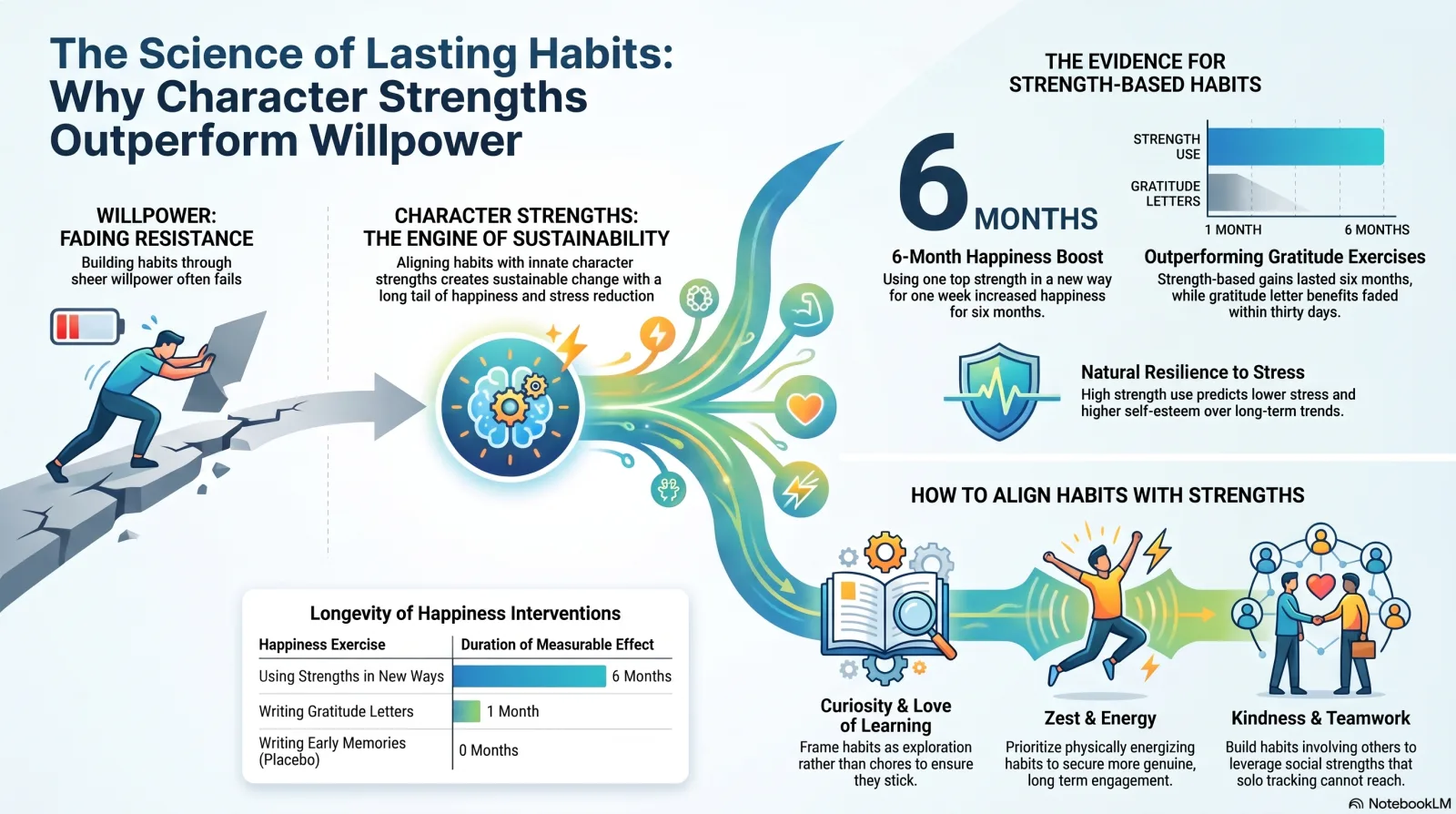
The exercise that outperformed everything else tested
Seligman, Steen, Park, and Peterson (2005) ran six-group, placebo-controlled trials of five candidate happiness interventions against a control exercise (writing about early memories). One intervention asked participants to identify their top strengths and use one of them in a new and different way every day for a week.
It won, by a wide margin. Happiness was measurably higher than the placebo group's at one week, one month, three months, and six months after the exercise ended. Depression scores dropped too, with effects showing up immediately and holding through the same six-month window. For comparison, a well-known gratitude exercise in the same study - writing and delivering a letter of thanks - produced gains that faded within a month. Using a strength in a new way was the only exercise tested whose effect was still detectable at six months.
A second study found the same shape without a lab exercise
Wood, Linley, Maltby, Kashdan, and Hurling (2011) followed 207 adults for six months without asking anyone to do a specific exercise. They just measured how much people already reported using their personal strengths, then checked in at three and six months. Strengths use at the start predicted less stress and greater self-esteem, vitality, and positive affect later - not as a one-time mood bump, but as a trend that kept moving in the same direction over half a year.
Two different designs, two different research groups, one consistent finding: using a strength you already have moves outcomes that most habit advice tries to reach through willpower instead.
What this means for choosing a habit
- Curiosity or love of learning: a habit framed as exploring something (a new skill, a topic, a recipe) sticks better than one framed as a chore you're checking off.
- Self-regulation or prudence: a habit built around structure and routine plays to strength rather than fighting your grain.
- Zest: a habit that's physically energizing will get more genuine engagement than one chosen purely for its health math.
- Perseverance: long, unglamorous habit chains (a daily log, a slow rebuild) are exactly where this strength does its work.
- Kindness or teamwork: a habit that involves someone else - a shared goal, a check-in - draws on strengths that solo tracking can't reach.
It's a hypothesis, not a guarantee
None of this means a strengths-aligned habit is automatically easy, and it isn't a substitute for tracking whether it's working, or for giving it the weeks it actually needs. It's a better starting bet than picking a habit at random or copying someone else's routine, and it's worth testing against your own record rather than taking on faith.
That's the part a log is for. Pick the habit, name the strength it's supposed to use, and let a few weeks of HabitSync's history show whether it's holding up better than the habits you built without that alignment.
Keep reading
- Why Your TDEE Calculator Number Is Wrong (and How to Fix It With Real Data) — TDEE calculators give you a population-average estimate. Here's how far off it can be, why it drifts as you diet, and how to replace it with your own data.
- How to Tell If a Medication Is Working (and What Else It's Doing) — Many medications take weeks to work, and population side-effect rates say nothing about you. One before/after method answers both questions from your own data.
- Why Just Tracking a Habit Can Start Changing It — Noticing an automatic behavior is often what breaks its grip, before you try to change anything. Here's why logging a habit works even on days you don't act.
- Why Your Habit Tracker and Your Pill Organizer Should Be the Same App — Most people log habits in one app and medications in another. The interesting answers live between those two datasets - and splitting them hides them.
- Never Miss a Dose Without a Single Alarm: The Visibility Method — Reminder apps assume more alarms mean better adherence - until dismissing the alarm becomes the habit. Try routine anchors and visible dose counts instead.
- How Long It Takes to Form a Habit: 18 to 254 Days — The 21-day rule has no study behind it. The research people cite found habit formation took 18 to 254 days, averaging 66. Here's what moves you in that range.
- Does Habit Tracking Work? What the Evidence Says — In an NIH-funded trial of nearly 1,700 people, those keeping daily food records lost twice as much weight. What tracking does, and where it stops helping.
- Why Habits Carry You on Your Worst Days — When willpower runs out, people don't make worse choices - they make more automatic ones. Depletion raised habitual choices 28-32%, good habit or bad.
- Why Old Habits Come Back (and What to Do Instead) — Habits don't get erased. Extinction reversed the neural signature of a rat's habit, then it returned the instant retraining began. What that means for relapse.
- Why Sharing a Streak Isn't the Same as Sharing Progress — Most habit trackers with friends just mirror checkmarks. HabitSync Groups compare the real numbers behind them, and only what you choose to share.
- Why Rigid Habit Trackers Don't Survive Contact With an ADHD Brain — HabitSync wasn't built for ADHD, but flexible goal types, honest miss tracking, and a history that never resets fit where rigid trackers break down.
- How to Find Out What's Actually Affecting Your Sleep and Mood — How to tell a pattern from a coincidence in your own sleep and mood data, and why testing dozens of factors at once needs a correction most apps skip.
- Why the Scale Stopped Moving When Your Diet Didn't — A stall usually means your maintenance calories moved, not that you lost discipline. Here's how to measure where maintenance sits now from your own data.
- What Separates a Medication Tracker From a Reminder App — Most medication apps are reminder apps that log a checkmark. Here's what to look for if you want to answer whether a medication is actually working.
- Some Habits Don't Pay Off the Same Day — Compare today's habit against today's mood and anything with a lag looks useless. Why delayed effects are common, and how to test for them at several delays.
- Sharing Progress Without Sharing Your Weight — Accountability groups usually mean handing over private numbers. Here's a sharing model where every metric is off by default and weight can be percent change.
- What a Mood Tracker App Actually Records — A daily 1-10 rating plus an optional emotion from a 25-square grid. Here is what a mood tracker app records, and what it can tell you afterward.
- How an Accountability App Works Without a Leaderboard — Join with a code, pick what you share per metric, and compare derived progress lines. No leaderboard, and your raw daily logs never leave your account.
- One Missed Day Doesn't Erase a Streak. All-or-Nothing Thinking Says It Does. — Dieters who only believed they'd eaten a bigger slice went on to eat more, not less. The same distortion turns one missed habit day into a lost week.
- Why Naming the Urge to Skip a Habit Works Better Than Fighting It — Putting a feeling into words measurably calms the brain's threat response. Smokers who practiced it cut cigarette use 26% without the urge itself weakening.
- Which App Should You Use to Track 75 Hard, 75 Soft, or Exodus 90? — 75 Hard, 75 Soft, and Exodus 90 all come with an official app built for that one program. Here's when a flexible tracker fits better, and when it doesn't.
- Group Habit Challenges: Spiritual Fitness, Habit Stacking, and Mastermind Formats — Spiritual fitness challenges, habit stacking, trinity challenges, and masterminds share one mechanic: habits tracked together. Here's how to set one up.
- Can You Trust the 'Insights' Your Habit Tracker Shows You? — We ran our own correlation engine on pure random data and it found 24 fake patterns, some labeled 'strong.' Here's the statistics that get it to zero.
- Why Most Habit Stacking Apps Don't Actually Stack Anything — Most habit stacking apps just let you list habits. Real stacking chains a new one onto a routine you already run, then tracks the chain, not each habit alone.
If you want to see this in the app, here is how HabitSync tracks habits.