Why Habits Carry You on Your Worst Days
6 min read · Updated 2026-07-18
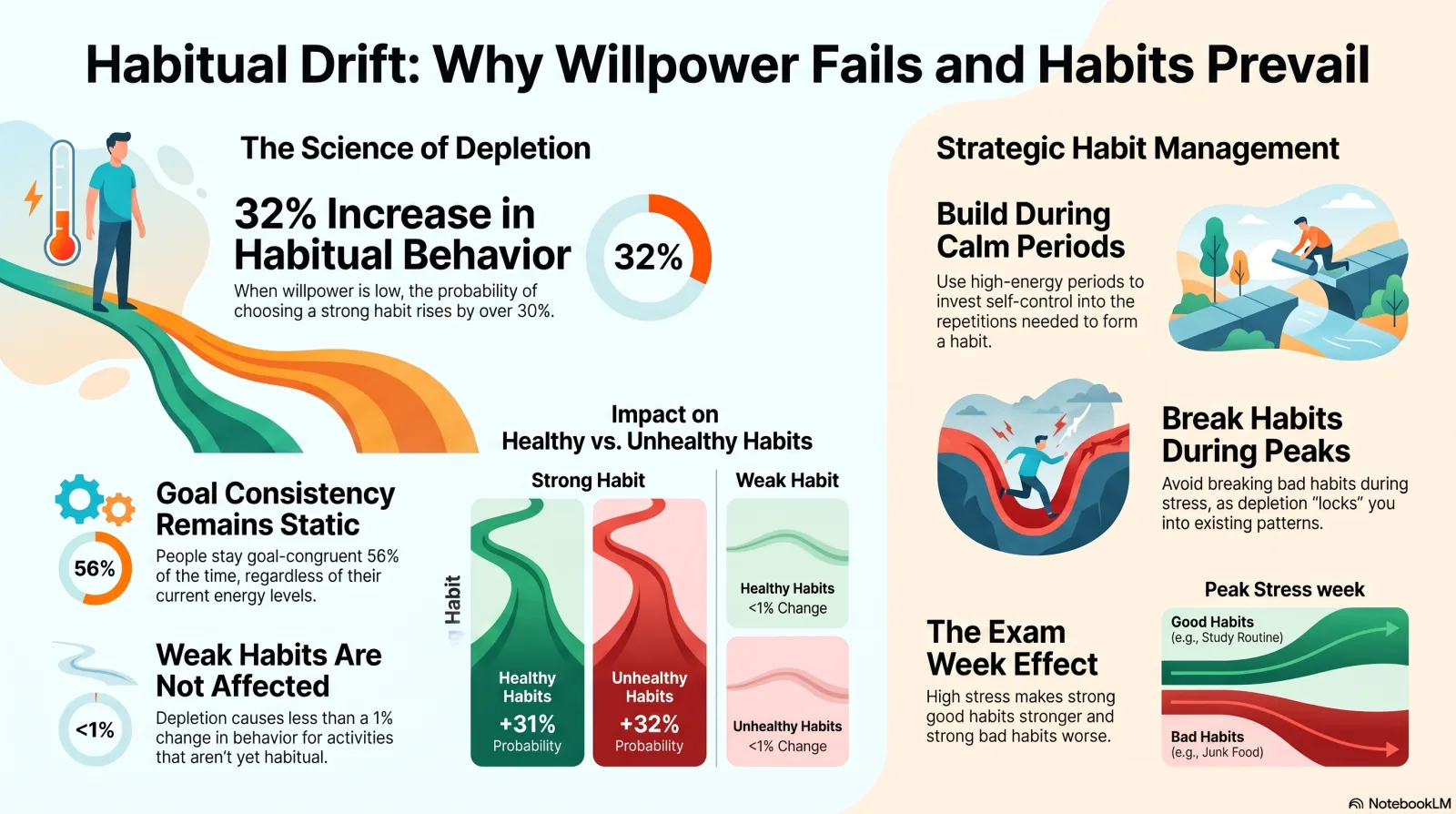
When self-control is depleted, people don't suddenly start making bad decisions. They fall back on whatever they've done before. Across four studies, depletion raised the odds of choosing a strongly habitual option by 28-32%, and it made no difference whether that option was healthy or unhealthy. Weak habits barely moved.
The standard story about willpower is that running out of it makes you do the wrong thing. You get tired, discipline slips, and you eat the cookie.
Neal, Wood and Drolet tested this across five studies in 2013 and found something different. Depleted people didn't shift toward bad choices. They shifted toward familiar ones. Whether that helped or hurt depended entirely on what they'd already built.
The number that reframes it
In their fourth study, reduced self-control raised the probability of choosing a strongly habitual snack by 32% when the snack was unhealthful, and by 31% when it was healthful. Nearly identical. For weakly habitual options the increase was under 1%.
An earlier study with MBA students found the same shape: 28% for unhealthful habitual options, 21% for healthful ones, and 2% for weak habits either way. Depletion isn't pulling people toward junk. It's pulling them toward repetition, and the researchers describe the mechanism as blind to what you're currently trying to accomplish.
The clearest version of this is in their four-day diary study. Goal-congruent behaviors happened 56% of the time on depletion days and 56% of the time on non-depletion days. Statistically indistinguishable. What changed wasn't the ratio of good choices to bad ones. It was the ratio of habitual behavior to deliberate behavior.
It was repetition, not reasoning
The obvious objection is that tired people are just taking a sensible shortcut, defaulting to a known-good option to save effort. The researchers tested that directly with a mediation analysis on three candidate explanations.
Only one held up: unthinkingly choosing one's normal snack. Confidence in the outcome didn't mediate the effect. Perceived value of the option didn't either. Both confidence intervals crossed zero. Depleted people weren't reasoning their way to a default. They were repeating.
They also weren't rationalizing after the fact. Depletion didn't change how much people liked the snacks, and it didn't change how healthy they rated them.
The exam-week study is the strange one
Their first study tracked 65 students over ten weeks, using exam periods as the depletion condition. Strong bad habits got worse during exams, which nobody would find surprising. Strong good habits also got stronger, which is the part worth sitting with. Weak habits, good or bad, didn't move at all.
The newspaper result is the sharpest test in the paper. Habitual newspaper reading went up during exam weeks, even though exams create time pressure that should push all optional reading down. The habit was strong enough to run against the circumstances that should have suppressed it.
What this means if you keep failing at consistency
Most consistency advice is aimed at the wrong stage. Willpower is what you spend building a habit. It's not what a habit runs on afterward. Wood and Runger make the same point from the other direction: people with high trait self-control don't seem to reach their goals by suppressing temptation. They reach them by having built habits that don't generate much temptation to begin with.
There's a corollary in the fifth study, and it's less flattering. People lower in trait self-control leaned harder on whichever study method was already their strongest habit, relying on it more heavily than higher self-control students did. If your one strong habit happens to be a good one, that works out. If it isn't, depletion hands you straight to it.
- Start new habits when life is calm. Repetitions are what you need, and repetitions cost self-control until the habit takes over.
- Try to break a bad habit when your self-control is high, not when you are already worn down - the authors make this recommendation explicitly.
- Judge a habit by how it holds up during your worst weeks, not your best ones. A streak built entirely on good weeks hasn't been tested.
One honest limit
A companion study on exercise in the same paper failed. Trait self-control turned out to be unrelated to how often people exercised, and the authors attribute this to exercise simply not being an important goal for many of their participants. Worth reporting, because it's a real boundary on the finding: none of this describes behaviors you were never particularly invested in.
HabitSync's matrix shows misses as plainly as completions, on purpose. A streak counter tells you about your good stretches. The full grid shows which habits survived the bad ones, and that's the more useful thing to know.
Keep reading
- Why Your TDEE Calculator Number Is Wrong (and How to Fix It With Real Data) — TDEE calculators give you a population-average estimate. Here's how far off it can be, why it drifts as you diet, and how to replace it with your own data.
- How to Tell If a Medication Is Working (and What Else It's Doing) — Many medications take weeks to work, and population side-effect rates say nothing about you. One before/after method answers both questions from your own data.
- Why Just Tracking a Habit Can Start Changing It — Noticing an automatic behavior is often what breaks its grip, before you try to change anything. Here's why logging a habit works even on days you don't act.
- Why Your Habit Tracker and Your Pill Organizer Should Be the Same App — Most people log habits in one app and medications in another. The interesting answers live between those two datasets - and splitting them hides them.
- Never Miss a Dose Without a Single Alarm: The Visibility Method — Reminder apps assume more alarms mean better adherence - until dismissing the alarm becomes the habit. Try routine anchors and visible dose counts instead.
- How Long It Takes to Form a Habit: 18 to 254 Days — The 21-day rule has no study behind it. The research people cite found habit formation took 18 to 254 days, averaging 66. Here's what moves you in that range.
- Does Habit Tracking Work? What the Evidence Says — In an NIH-funded trial of nearly 1,700 people, those keeping daily food records lost twice as much weight. What tracking does, and where it stops helping.
- Why Old Habits Come Back (and What to Do Instead) — Habits don't get erased. Extinction reversed the neural signature of a rat's habit, then it returned the instant retraining began. What that means for relapse.
- Why Sharing a Streak Isn't the Same as Sharing Progress — Most habit trackers with friends just mirror checkmarks. HabitSync Groups compare the real numbers behind them, and only what you choose to share.
- Why Rigid Habit Trackers Don't Survive Contact With an ADHD Brain — HabitSync wasn't built for ADHD, but flexible goal types, honest miss tracking, and a history that never resets fit where rigid trackers break down.
- How to Find Out What's Actually Affecting Your Sleep and Mood — How to tell a pattern from a coincidence in your own sleep and mood data, and why testing dozens of factors at once needs a correction most apps skip.
- Why the Scale Stopped Moving When Your Diet Didn't — A stall usually means your maintenance calories moved, not that you lost discipline. Here's how to measure where maintenance sits now from your own data.
- What Separates a Medication Tracker From a Reminder App — Most medication apps are reminder apps that log a checkmark. Here's what to look for if you want to answer whether a medication is actually working.
- Some Habits Don't Pay Off the Same Day — Compare today's habit against today's mood and anything with a lag looks useless. Why delayed effects are common, and how to test for them at several delays.
- Sharing Progress Without Sharing Your Weight — Accountability groups usually mean handing over private numbers. Here's a sharing model where every metric is off by default and weight can be percent change.
- What a Mood Tracker App Actually Records — A daily 1-10 rating plus an optional emotion from a 25-square grid. Here is what a mood tracker app records, and what it can tell you afterward.
- How an Accountability App Works Without a Leaderboard — Join with a code, pick what you share per metric, and compare derived progress lines. No leaderboard, and your raw daily logs never leave your account.
- Why Habits Built Around Your Character Strengths Actually Last — Using a signature strength in a new way for one week raised happiness for 6 months in a controlled study. Here's how to point a habit at one.
- One Missed Day Doesn't Erase a Streak. All-or-Nothing Thinking Says It Does. — Dieters who only believed they'd eaten a bigger slice went on to eat more, not less. The same distortion turns one missed habit day into a lost week.
- Why Naming the Urge to Skip a Habit Works Better Than Fighting It — Putting a feeling into words measurably calms the brain's threat response. Smokers who practiced it cut cigarette use 26% without the urge itself weakening.
- Which App Should You Use to Track 75 Hard, 75 Soft, or Exodus 90? — 75 Hard, 75 Soft, and Exodus 90 all come with an official app built for that one program. Here's when a flexible tracker fits better, and when it doesn't.
- Group Habit Challenges: Spiritual Fitness, Habit Stacking, and Mastermind Formats — Spiritual fitness challenges, habit stacking, trinity challenges, and masterminds share one mechanic: habits tracked together. Here's how to set one up.
- Can You Trust the 'Insights' Your Habit Tracker Shows You? — We ran our own correlation engine on pure random data and it found 24 fake patterns, some labeled 'strong.' Here's the statistics that get it to zero.
- Why Most Habit Stacking Apps Don't Actually Stack Anything — Most habit stacking apps just let you list habits. Real stacking chains a new one onto a routine you already run, then tracks the chain, not each habit alone.
- Does Alcohol Affect Sleep? What Two Reviews Found, and How to Check Your Own Nights — About two drinks is enough to delay and cut REM sleep, and falling asleep faster only showed up near five. What two reviews found, and how to check your nights.
If you want to see this in the app, here is how HabitSync tracks habits.