Can You Trust the 'Insights' Your Habit Tracker Shows You?
11 min read · Updated 2026-09-05
Every correlation feature in a tracking app runs the same kind of test: compare two piles of days and check whether the gap between them is bigger than noise. Run that test dozens of times and some gaps will look real by pure chance alone. We measured it on our own engine, then rebuilt five parts of it once we saw the number it came back with.
We fed our own correlation engine four hundred days of habits and medications logging nothing but random numbers, none of them connected to anything else, on purpose. It came back with a full list: 24 'patterns,' the most it will ever show at once. Several were labeled strong.
Every correlation feature in a habit or symptom tracker answers the same underlying question: on the days this happened, was that different? Split your days into two piles, compare the average outcome across them, check whether the gap is bigger than you'd expect from noise. It's a good method. Bearable popularized it for symptom tracking, and we've written before about why it beats staring at two wiggly line charts.
What that method doesn't protect you from, on its own, is asking the question too many times. One of the 24 was a habit rated strong for supposedly moving another habit, built on six days where the two happened to line up. Another was a medication rated strong for moving mood, compared against only four days where no dose had been logged at all. None of it was real, because there was nothing in the data to be real. The engine reported it anyway.
Prefer to listen?
Why tracking more habits ruins your data (6 min, AI-generated audio)
Two synthetic voices discussing this article. The numbers in it were checked against the same measurements the article reports, but nobody in the recording is a real person.
Read the transcript
Host A: Welcome back. Today we're diving into something that I think almost everyone with a smartphone has tried at least once: habit tracking. You download an app, you start logging your sleep, your coffee, your workouts, your mood, and you wait for the app to hand you those golden, life-changing insights.
Host B: Right, like: on days you meditate, your productivity goes up by twenty percent. It feels like magic. But the reality under the hood is a lot messier, and sometimes those insights are complete ghosts.
Host A: Ghost patterns. That's exactly what the authors of today's article decided to investigate. They did something brilliant and slightly chaotic: they fed their own correlation engine 400 days of completely random numbers, pure noise, absolutely unconnected to anything, just to see what the app would discover.
Host B: And what did it find?
Host A: It surfaced a whopping 24 patterns, which was actually the maximum display cap of their engine. Some of them were even flagged as strong correlations. For instance, it claimed a medication had a strong effect on mood, but when they looked at the raw data, it was comparing mood against only four days where no dose had been logged at all. Another strong habit correlation was built on just six days where two random events happened to line up by pure coincidence.
Host B: That is wild. It basically fabricated a whole narrative out of thin air. How does that happen?
Host A: It's all about how many questions you ask. Every time a tracking app looks for a correlation, it splits your days into two piles, days you did the habit and days you didn't, and checks if the gap between those piles is bigger than random noise. At a standard 5% significance threshold, any single test has a 1-in-20 chance of looking real by pure coincidence.
Host B: So if you only test one thing, you're probably fine. But who tracks just one thing?
Host A: Exactly. If you track ten habits and check them against three outcomes, say mood, sleep and weight, and you test those across two different lags, like same-day and next-day effects, you are suddenly running 10 times 3 times 2, so 60 comparisons, before lunch. At a 5% threshold, you should expect about three of those to look highly significant even if your data is nothing but a series of coin flips. The math isn't broken. You've just turned your habit tracker into a lottery machine.
Host B: Right, run enough tickets and you're bound to win something. So how did they fix it?
Host A: They rolled out a multi-part statistical audit. First, they used false discovery rate control via the Benjamini-Hochberg correction. This adjusts each finding p-value into a q-value to account for the total number of comparisons being run. But they realized that correction alone was not enough, because weak correlations with moderate q-values, under 0.25, were still slipping through.
Host B: So they tightened the constraints.
Host A: Exactly. They raised the sample size floor, so nothing gets compared now unless you have at least five days logged on each side. They also required a finding to clear both an uncorrected p-value under 0.05 and a corrected q-value under 0.25.
Host B: And didn't they change the actual test they use for yes-or-no questions?
Host A: Yes, that was a massive bug they uncovered. If you have small sample sizes and you treat yes-or-no data, like did I meditate today, with tests built for continuous numbers, you get false certainty. Five days of doing a habit next to five days of not doing it would compute to a p-value of exactly zero. Total certainty. But in reality, five wins in a row against five losses can happen by pure chance about 1 in 126 times. To fix this they implemented Fisher's exact test, which calculates the honest mathematical probability for small-sample count data.
Host B: That makes so much sense. It stops the app from screaming 100% correlation when you've only been tracking for a week. What about those delay windows? You mentioned lags.
Host A: Yes. Previously the engine would scan up to seven days of delays to see if, say, a workout on Monday affected your mood on Friday. On random noise, that's just more lottery tickets. So they bounded the lags based on biological plausibility. Simple behavioral habits are now only tested for same-day or next-day effects, 0 to 1 days, while things like medications are allowed longer windows. This dropped the total comparisons on their test data from roughly 3,800 down to just 1,000, eliminating thousands of opportunities to get lucky.
Host B: Fascinating. But here's the catch for the user: if the app is now being much more mathematically strict, doesn't that make it harder to find real patterns?
Host A: It does, and they measured that cost of sensitivity directly. If you have a real, gym-sized effect on your mood and you track it for 60 days: if you only track 3 habits, the engine catches that real effect 88% of the time. If you expand and track 20 habits, your chance of detecting that exact same real effect drops to just 43%.
Host B: Wait, so tracking more things actually makes you less likely to find the real patterns?
Host A: Yes. Because the multiple-comparisons correction has to get harsher to protect you from lies as your list of tracked habits grows. Adding variables doesn't make the app invent lies any more. It just makes the app go quiet. You're buying a much longer wait for the same insights.
Host B: So the sweet spot is really keeping it focused.
Host A: Exactly. The practical recommendation is to track only three to five habits that you genuinely care about at any one time.
Host B: And how long do we need to log before we can trust these insights?
Host A: Around 60 days of near-daily logging is the mathematical sweet spot for a strong effect. And there is a convergence here: 60 days of data logging is close to the 66-day average it takes for a habit to become automatic, based on Lally's classic study.
Host B: Although Lally found a massive fourteenfold spread, anywhere from 18 to 254 days for a habit to actually form.
Host A: Right, so we shouldn't treat 66 days as a fixed biological law. But the math of data logging and the biology of habit formation happen to land in the same neighborhood. Roughly by the time a behavior stops feeling like a daily decision, your app finally has enough arithmetic history to tell you what it actually changed.
Host B: It's a coherent two-month stretch: build the behavior, then find out what it does. But even if you clear all these statistical bars and the app hands you a strong pattern, that still doesn't prove cause and effect, right?
Host A: Exactly. It rules out coincidence, but it can't tell you if the gym improved your mood, or if you only went to the gym because you were already in a great mood. The next step is always the manual one: run a deliberate, focused experiment. Change one thing on purpose, keep everything else steady, and watch what happens.
Host B: Ground your data, limit your variables, and be patient. It turns out a quiet habit tracker is the most honest companion you can have. Thanks for joining us, and happy tracking.
One test, run enough times, always finds something
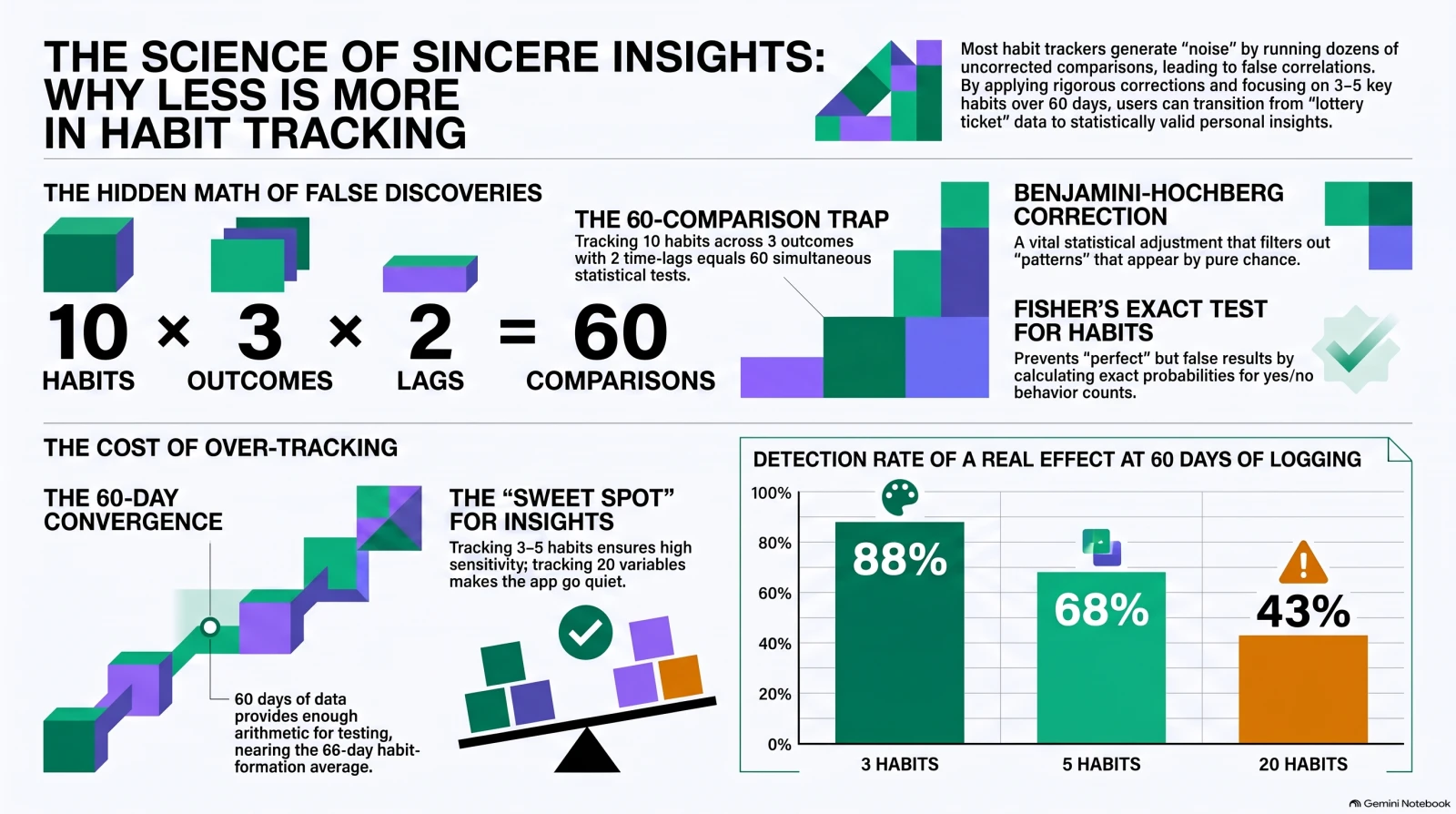
Run one comparison at the usual 5% significance threshold and a coincidence has a 1-in-20 shot of looking real. Track ten habits and check each one against mood, sleep, and weight change, and you've run somewhere around sixty comparisons before lunch. At that threshold, you should expect about three of them to come back looking significant even if nothing in your life is connected to anything else.
That's not a flaw in the math. The math is doing exactly what you asked it to. The flaw is treating a p-value earned by asking sixty questions the same as one earned by asking a single question you actually cared about.
The fix has a name: false discovery rate control, and we've covered the mechanics of it elsewhere. What surprised us running it against random data is that the correction alone wasn't enough.
The correction wasn't the whole fix
Benjamini-Hochberg adjusts each finding's p-value into a q-value that accounts for how many comparisons ran alongside it. It was already in the engine before we ran this audit, and it's the right tool. It still let patterns through, because a q-value under the usual 0.05 cutoff isn't the only bar something can clear. Anything under about 0.25 got labeled a moderate pattern, and on a big enough batch of noise, some q-values land right in that gap by construction, not by mistake.
So the cap came down and the sample-size floor went up. Nothing gets compared with fewer than five days on each side now, up from four. And a finding needs both an uncorrected p-value under 0.05 and a corrected q-value under 0.25 before it shows up anywhere, not just a gap that looked big enough on its own.
A coin flip isn't a p-value of zero
There's a second kind of question buried in this list that a plain average-of-two-piles test can't answer honestly: did one habit happening also mean a second one got done that day? That's not a number with an average and a spread. It's a yes or no, counted twice, once per pile. Treating those counts as 0s and 1s and running the same test built for continuous numbers works fine at forty days a side. At five, it doesn't.
We had exactly that bug. Five days where a habit got done every single time, next to five days where a second habit never did, computed to a p-value of exactly zero. Certain. Except five wins in a row against five losses in a row is a real thing that happens by pure chance about 1 time in 126, which is nowhere near certain.
Fisher's exact test asks the right question directly: given how many total yeses there were, how many ways could they have landed the way they did? A concrete version, ten days logged, meditation happening on 8 of 10 gym days and 2 of 10 other days:
| Feature | Meditated | Didn't |
|---|---|---|
| Gym day | 8 | 2 |
| Other day | 2 | 8 |
Fisher's exact test on that table comes back at about 2.3%, meaning a split this lopsided happens roughly 1 time in 43 by chance. Worth noticing. Run the same test on the five-wins-versus-five-losses case from earlier and it comes back at about 0.8%, not zero, which is the honest number and still enough to flag as a lead worth watching, not a certainty worth acting on.
A three-day gap between two habits doesn't mean anything
The engine can also test whether an effect shows up later rather than the same day: does today's workout move tomorrow's mood, does it show up three days later, a week later. Scanning every delay for every pair used to be standard here, checking eight different shifts, zero through seven days, for every single comparison.
On real habits and medications that's a reasonable thing to want. On random data it's a lottery. There's no mechanism by which one made-up habit should predict another three days later, so when the scan found one, that's what a lottery looks like: the winning number is uniformly random, and on the random data we tested, the winning lag really was spread evenly across zero through seven.
The fix bounds which delays get tested by what could plausibly carry an effect at all:
| Feature | Delays tested (days) |
|---|---|
| A habit, a night's sleep, a weekend, or a day-note tag | 0, 1 |
| Staying under a calorie target, against weight change | 0, 1, 2, 3, 7, 14 |
| A medication or supplement | 0, 1, 2, 3, 7, 14, 21, 28 |
Behavior acts today or tomorrow. A skipped workout that's still quietly moving something three days later has already passed through the same-day and next-day comparisons on the days in between. A medication or a supplement is different: those can take weeks to show anything at all. We've written before about when a lag makes sense and when it doesn't; this is the part that now enforces it instead of asking a person to eyeball it. Fewer delays tested means fewer chances to get lucky, which is most of why the count of comparisons on the same random data dropped from around 3,800 to about 1,000.
The bug that was staring at us
The last one wasn't a statistics problem. It was a bookkeeping one, and we only found it by looking for the other ones.
Picture an account thirty days old, being analyzed over a sixty-day window, on a medication taken every single day since signup. At any of the longer delays the engine tests, from a week out to a month, there are no days anywhere in the window where the medication wasn't taken. The only days without a dose logged are the days before the account existed. Comparing those two piles reported the medication moving mood at one of those delays. What it had actually found was the difference between a month with an account and a month without one.
The fix is one sentence: a day with nothing logged at all can never count as evidence that something didn't happen. It just means nobody was there to write it down.
What changed, measured
We ran a fresh batch of pure noise after every fix landed: twenty habits and five medications logging random numbers across four hundred days, and separately a smaller batch of ten habits and three medications, to check the fix at a different scale. Strong patterns, the ones cleared to lead a sentence with real confidence, came back at zero in every run, at every window we checked. Moderate patterns, which are allowed a real error rate by design, up to one in four, still turned up once or twice in some runs and not at all in others. That's not a residual bug. That's what a one-in-four tolerance is supposed to look like on data with nothing in it.
| Feature | Before every fix | After |
|---|---|---|
| Patterns surfaced from pure random data | 24, its display cap, every run | Strong: 0 in every run. Moderate: 0 to 3, as its tolerance allows |
| Comparisons tested (20 habits, 400 days) | ~3,800 | ~1,000 |
| Minimum days required on each side | 4 | 5 |
| A perfect run's p-value (5 wins straight vs 5 losses straight) | 0 | ~0.8% |
So how much do you have to log before any of this works?
Tightening the bar is only half an answer. The other half is what it costs you, and we didn't have a number for that either, so we measured it the same way. Plant one habit with a genuine effect on mood, surround it with habits that do nothing, and count how often the engine catches the real one. A hundred and twenty runs per combination.
The effect we planted is the size of a good gym day, about 1.5 points of mood. Read this as the share of runs where the engine found it:
| Feature | 21 days | 30 days | 60 days | 90 days | 120 days |
|---|---|---|---|---|---|
| Tracking 3 habits | 23% | 42% | 88% | 99% | 98% |
| Tracking 5 habits | 11% | 27% | 68% | 93% | 99% |
| Tracking 10 habits | 13% | 25% | 69% | 86% | 97% |
| Tracking 20 habits | 1% | 9% | 43% | 69% | 95% |
Two things fall out of that table. The first is that three weeks is not a slow start, it's nothing, at every width we tested. The second is the price of tracking more: at sixty days, three habits catches a real effect 88% of the time and twenty catches it 43%. Same person, same effect, same two months of logging, half the chance of hearing about it.
So the practical recommendation is three to five things you genuinely care about, if you want answers inside a couple of months. Track twenty and you are not getting more insight, you are getting a longer wait for the same one.
The cost is sensitivity, though, not lies. Across every run above, habits that did nothing were reported as moving mood between 0.00 and 0.19 times per run, and that number went down as the habit count went up, because the correction gets harsher as the list grows. Adding variables doesn't make the app invent more. It makes it go quiet.
Two caveats we would rather state than bury. A subtle effect, something like half a point of mood, stays out of reach on any normal timeline: 46% at a hundred and twenty days with three habits, 13% with twenty. And every number above assumes a habit done on about half of days, which is the easiest case there is. A habit you manage 85% of the time leaves a very small pile to compare against, and does worse than this.
Sixty days to measure a habit, sixty-six to build one
There is a number we deliberately refuse to give you, and it sits right next to this one. How long a habit takes to become automatic came out at an average of 66 days in Lally's field study, with individuals landing anywhere from 18 to 254. A fourteenfold spread. We won't promise you a formation date, because the research doesn't support promising anyone one.
The detection number is a different kind of claim, and that's why we'll put it in writing. How long your habit takes to form is biology. How long until there is enough data to test what it did is arithmetic, and arithmetic generalizes.
Worth noticing that they land in the same neighborhood. By roughly the time a habit stops being a decision, you have roughly enough history to ask what it changed. Those are two unrelated processes that happen to converge, not a law, but it does make the first two months a coherent stretch: build the thing, then find out.
It also means your first month of data on a brand-new habit is measuring a behavior that is still changing shape. That's another reason the early answers come back empty, on top of the sample size.
What none of this fixes
A pattern that survives all of this is still a pattern, not a cause. If your mood is higher on days you go to the gym, that's consistent with the gym helping and equally consistent with good days being the ones you make it there in the first place. Nothing in a p-value or a corrected q-value settles which. The honest next step is the boring one: change one thing on purpose, leave everything else alone, and watch what happens over the following weeks. We've written about running that experiment properly.
It also can't manufacture a finding out of three weeks of data. A brand-new account clears none of these bars for most pairs, and the honest answer is 'keep logging,' not a pattern dressed up to look like one. That's meant to feel disappointing on day four. It's the same discipline that kept the random data honest.
- It can't tell an antidepressant from a blood pressure medication. A dose is a dose. What it treats is something only you know, so a medication effect never gets ranked as more or less expected than any other one until you say so.
- It won't call a next-morning weight drop progress if the same drop is back within a week. That's water, not fat, and the engine checks the week before it colors anything green.
None of this is visible from the outside. Every one of these fixes shows up as a card that no longer appears, a lag that no longer gets offered, a 'strong' that quietly becomes nothing. The measure of whether it worked isn't a feature you can screenshot. It's a habit tracker that stops telling you things about yourself that a coin flip could have told you just as easily.
How many habits should I track at once?
Three to five, if you want the correlation analysis to tell you anything inside a couple of months. We tested this against our own engine: with a real, gym-sized effect on mood, tracking three habits found it in 88% of runs at sixty days, while tracking twenty found it in 43%. Every variable you add raises the multiple-comparisons bar for all of them, so more tracking buys you a longer wait rather than more answers.
How long until a habit tracker can tell me anything useful?
Around two months of near-daily logging for a strong effect, and longer if you track a lot of things at once or the effect is subtle. Three weeks catches almost nothing, which is a property of the sample size rather than a fault in the app. It lands close to the 66-day average for habit formation itself, so roughly the point a habit stops feeling like a decision is roughly the point you can start asking what it changed.
Are habit tracker correlations statistically valid?
It depends on whether the app corrects for how many comparisons it ran. A single p-value on one comparison can be valid on its own and still be misleading once it's one of dozens run the same day, because some fraction of dozens will look significant by chance alone. Ask whether the tool mentions a correction like Benjamini-Hochberg or false discovery rate control. If it doesn't, treat every 'insight' as one lottery ticket among many.
What statistical test should a habit or symptom tracker use?
It depends on what's being compared. A numeric outcome like mood or sleep duration calls for a t-test on the two groups of days. A yes-or-no outcome, like whether a second habit also happened, needs a test built for counts, like Fisher's exact test, especially with fewer than a few dozen days on each side. Using a t-test on yes-or-no data at small sample sizes is a common source of overconfident results.
Why do a habit tracker's insights disappear after I add more habits?
That's usually the multiple-comparisons correction doing its job, not a bug. Tracking ten habits instead of three means testing far more pairs, and a tool that adjusts for that raises the bar for every individual finding as the total number of questions goes up. Fewer, more trustworthy patterns showing up after you add habits is the expected result of a correction working correctly.
Does a 'strong pattern' label mean the habit is causing the outcome?
No. It means the gap between the two groups of days is bigger than pure chance would plausibly produce, given how many comparisons were checked. That rules out coincidence. It doesn't rule out a third factor driving both, or the causation running the other direction. Treating a strong pattern as a hypothesis worth testing deliberately is the right level of confidence. Treating it as settled isn't.
Keep reading
- Why Your TDEE Calculator Number Is Wrong (and How to Fix It With Real Data) — TDEE calculators give you a population-average estimate. Here's how far off it can be, why it drifts as you diet, and how to replace it with your own data.
- How to Tell If a Medication Is Working (and What Else It's Doing) — Many medications take weeks to work, and population side-effect rates say nothing about you. One before/after method answers both questions from your own data.
- Why Just Tracking a Habit Can Start Changing It — Noticing an automatic behavior is often what breaks its grip, before you try to change anything. Here's why logging a habit works even on days you don't act.
- Why Your Habit Tracker and Your Pill Organizer Should Be the Same App — Most people log habits in one app and medications in another. The interesting answers live between those two datasets - and splitting them hides them.
- Never Miss a Dose Without a Single Alarm: The Visibility Method — Reminder apps assume more alarms mean better adherence - until dismissing the alarm becomes the habit. Try routine anchors and visible dose counts instead.
- How Long It Takes to Form a Habit: 18 to 254 Days — The 21-day rule has no study behind it. The research people cite found habit formation took 18 to 254 days, averaging 66. Here's what moves you in that range.
- Does Habit Tracking Work? What the Evidence Says — In an NIH-funded trial of nearly 1,700 people, those keeping daily food records lost twice as much weight. What tracking does, and where it stops helping.
- Why Habits Carry You on Your Worst Days — When willpower runs out, people don't make worse choices - they make more automatic ones. Depletion raised habitual choices 28-32%, good habit or bad.
- Why Old Habits Come Back (and What to Do Instead) — Habits don't get erased. Extinction reversed the neural signature of a rat's habit, then it returned the instant retraining began. What that means for relapse.
- Why Sharing a Streak Isn't the Same as Sharing Progress — Most habit trackers with friends just mirror checkmarks. HabitSync Groups compare the real numbers behind them, and only what you choose to share.
- Why Rigid Habit Trackers Don't Survive Contact With an ADHD Brain — HabitSync wasn't built for ADHD, but flexible goal types, honest miss tracking, and a history that never resets fit where rigid trackers break down.
- How to Find Out What's Actually Affecting Your Sleep and Mood — How to tell a pattern from a coincidence in your own sleep and mood data, and why testing dozens of factors at once needs a correction most apps skip.
- Why the Scale Stopped Moving When Your Diet Didn't — A stall usually means your maintenance calories moved, not that you lost discipline. Here's how to measure where maintenance sits now from your own data.
- What Separates a Medication Tracker From a Reminder App — Most medication apps are reminder apps that log a checkmark. Here's what to look for if you want to answer whether a medication is actually working.
- Some Habits Don't Pay Off the Same Day — Compare today's habit against today's mood and anything with a lag looks useless. Why delayed effects are common, and how to test for them at several delays.
- Sharing Progress Without Sharing Your Weight — Accountability groups usually mean handing over private numbers. Here's a sharing model where every metric is off by default and weight can be percent change.
- What a Mood Tracker App Actually Records — A daily 1-10 rating plus an optional emotion from a 25-square grid. Here is what a mood tracker app records, and what it can tell you afterward.
- How an Accountability App Works Without a Leaderboard — Join with a code, pick what you share per metric, and compare derived progress lines. No leaderboard, and your raw daily logs never leave your account.
- Why Habits Built Around Your Character Strengths Actually Last — Using a signature strength in a new way for one week raised happiness for 6 months in a controlled study. Here's how to point a habit at one.
- One Missed Day Doesn't Erase a Streak. All-or-Nothing Thinking Says It Does. — Dieters who only believed they'd eaten a bigger slice went on to eat more, not less. The same distortion turns one missed habit day into a lost week.
- Why Naming the Urge to Skip a Habit Works Better Than Fighting It — Putting a feeling into words measurably calms the brain's threat response. Smokers who practiced it cut cigarette use 26% without the urge itself weakening.
- Which App Should You Use to Track 75 Hard, 75 Soft, or Exodus 90? — 75 Hard, 75 Soft, and Exodus 90 all come with an official app built for that one program. Here's when a flexible tracker fits better, and when it doesn't.
- Group Habit Challenges: Spiritual Fitness, Habit Stacking, and Mastermind Formats — Spiritual fitness challenges, habit stacking, trinity challenges, and masterminds share one mechanic: habits tracked together. Here's how to set one up.
- Why Most Habit Stacking Apps Don't Actually Stack Anything — Most habit stacking apps just let you list habits. Real stacking chains a new one onto a routine you already run, then tracks the chain, not each habit alone.
- Does Alcohol Affect Sleep? What Two Reviews Found, and How to Check Your Own Nights — About two drinks is enough to delay and cut REM sleep, and falling asleep faster only showed up near five. What two reviews found, and how to check your nights.
If you want to see this in the app, here is how HabitSync tracks habits.